
If you read enough trading books, you will eventually encounter the Golden Rule of Risk Management:
“Never risk more than 1% or 2% of your account on a single trade.”
It is safe advice. It is prudent advice. It is advice designed to keep you from blowing up.
But it is also arbitrary.
Why 1%? Why not 0.5%? Why not 5%?
If you have a setup with a high win rate and a solid payout, betting 1% isn’t “safe”—it’s mathematically negligent. You are leaving free growth on the table.
I am a Tax Consultant. I don’t like arbitrary numbers. I like formulas.
So I don’t use the “1% Rule.” I use the Kelly Criterion.
(This is not financial advice. I am a stranger on the internet. Do not bet the farm.)
The Formula
The Kelly Criterion was developed by John Kelly at Bell Labs in 1956. It answers the most important question in betting:
“Given my edge, what is the optimal amount to bet to maximize wealth growth?”
The formula looks like this:
f = (bp – q) / b
Let’s translate that into Trader Speak:
- f = The percentage of your account to risk.
- b = The odds received (your Reward-to-Risk ratio).
- p = Probability of winning (Win Rate).
- q = Probability of losing (1 – p).
A Realistic Example: Let’s use a standard, “bread and butter” scalping strategy. It doesn’t win every time, but it wins more than it loses, and the wins are slightly bigger than the losses.
- Win Rate (p): 55% (0.55)
- Reward-to-Risk (b): 1.25 (You risk $100 to make $125)
Kelly % = ((1.25 x 0.55) – 0.45) / 1.25 = 0.19
The math says you should risk 19% of your bankroll on this trade. If you bet less, you grow slower. If you bet more, you risk ruin.
(This is still not financial advice. Seriously, 19% is terrifying. Read on.)
The Danger of “Full Kelly”
If you are looking at that “19%” number and feeling nauseous, you are sane.
This is known as “Full Kelly.” And while it is mathematically optimal for maximum growth, it is psychologically impossible for a human being to withstand.
Full Kelly is a wild ride. It accepts massive volatility in exchange for massive growth. If you hit a losing streak (which will happen, even with a 55% win rate), Full Kelly will draw your account down by 50% or 60% in a heartbeat.
Most traders hit their Absorbing Barrier (or just quit) long before the math works out.
Also, Full Kelly assumes you know your variables perfectly.
- Do you know your win rate is exactly 55%?
- Do you know your Reward is exactly 1.25?
- What about fees? Fees reduce your “b” (odds). If you don’t factor in the exchange’s cut, you are overbetting.
In the real world, our numbers are fuzzy. And if you overestimate your edge while betting Full Kelly, you will go to zero.
(Did I mention this is not financial advice? Because if you mess this up, you will lose money.)
But wait, you might ask: “If I am only calculating a percentage of my total, how could I ever hit zero? Even if I draw my account down to $10, and risk 19%, I still have $8.10 left. Theoretically, I can trade forever.”
In the spot market, that is true. In the futures market, it is a lie. The answer is Leverage.
Most crypto trading platforms allow you to use leverage—basically borrowing money to increase your position size. When you calculate your Kelly bet, you are sizing your position based on your Stop Loss. You are telling the math: “I will lose 19% of my account IF the price hits this specific level.”
But here is the wrinkle: Have you ever moved your Stop Loss?
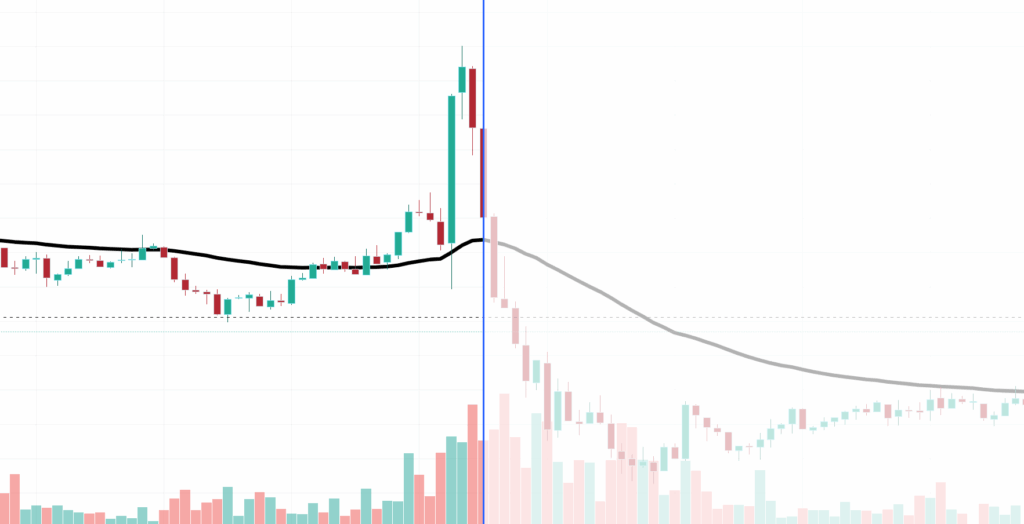
Have you ever been so convinced that your position was sound—that the market was “wrong”—that you nudged your stop down as the price approached it? Maybe you even deleted it outright to avoid a “wick”?
I don’t know a single trader who can honestly say they have never done this. (Well, other than that guy who started yesterday. But I haven’t checked on him since lunch, so he has probably done it by now, too.)
The Math of the Mistake: Let’s say you have a $10,000 account. Kelly tells you to risk $1,900 (19%). Your strategy relies on a tight Stop Loss (1% away from entry). To make the math work, you open a huge position using 20x Leverage.
- The Plan: If price drops 1%, you lose $1,900. You survive.
- The Reality: You panic and delete the Stop Loss.
Because you are leveraged 20x, a simple 5% drop in price doesn’t lose you 5%. It loses you 100%. You didn’t just lose your “risk amount.” You got liquidated. The exchange took the entire $10,000, and the Kelly Criterion cannot help you when you are dead.
And let me tell you – that sickening feeling when you are on the wrong side of your initial stop loss, and moving farther away is SO much worse than the feeling of just hitting your stop loss. If you haven’t felt that feeling – you don’t want to.
How I Actually Use It: “Fractional Kelly”
I trust the math, but I also respect the uncertainty.
So I use a Fractional Kelly strategy—usually Quarter Kelly.
In our example above, the formula says the optimal bet is 19%.
I take that number and multiply it by 0.25.
My actual risk is 4.75%.
Wait a minute.
Most textbooks scream at you to never risk more than 1% or 2%.
But here, the math is suggesting nearly 5%.
This is the power of the formula.
- When the edge is strong: The 1% rule holds you back. If you have a strategy that wins 55% of the time with positive R, risking only 1% drastically slows your compounding. The math gives you permission to be aggressive (4.75%).
- When the edge is weak: If your stats were lower (say, 40% win rate with 1.6 Risk/Reward), the Kelly formula outputs a tiny number: 2.5%. In that case, the standard advice to “Risk 2%” is actually dangerously close to Full Kelly. It leaves zero margin for error.
- But it gets worse when you add fees. That 1.6 Risk/Reward ratio is likely your gross return. But in crypto, you pay fees—often “Taker” fees on both the entry and the exit. If you are using leverage on small timeframes, those fees are calculated on your position size, not your margin.
- Note: We will do a deep dive on fee optimization and “Maker vs. Taker” strategies in a future post.
- If those fees reduce your effective payout from 1.6 to 1.4, look what happens to the math:
- Kelly % = ((1.4 x 0.40) – 0.60) / 1.4 = -2.8%
- The number is negative. Once fees are accounted for, your “winning strategy” is actually a losing one. If you followed the standard “2% Rule” here, you wouldn’t just be over-betting; you would be paying the exchange to slowly bankrupt you.
- Quarter Kelly protects you from this. If the edge is that thin, the fraction keeps you out of the market entirely. (Warning: If you bet the rent money and lose, the landlord will not accept “But the Kelly Criterion said so” as a valid excuse.)
The difference is that the market dictates my risk size, not my fear.
When the setup is A+, the math tells me to swing hard. When the setup is B-, the math forces me to be conservative.
(I am a Tax Consultant. I don’t like arbitrary numbers. I like formulas. But please remember: I am a stranger on the internet. Do not bet the farm based on a blog post.)
The Input Problem
The Kelly Criterion is a garbage-in, garbage-out machine.
If you think you have a 70% win rate because you had a lucky week, Kelly will tell you to bet your house. Then the Law of Large Numbers will show up and take your house.
You need hundreds of trades to know your Win Rate with any precision. Until you have that data, you are just guessing.
*(This is definitely not financial advice. Do not guess with your mortgage.)
The Future: The Time Machine
Knowing your optimal bet size is step one. But wouldn’t it be nice to see the future? To know what your account balance might look like after 1,000 trades using this strategy?
We can’t predict the future, but we can simulate it.
In a future post, we are going to feed these Kelly Criterion numbers into a Monte Carlo Simulation—a tool that plays out your trading year 10,000 times in seconds to see if you end up with a Lambo or a cardboard box.
Until then, respect the math. But fear the variance.
(This strategy works until it doesn’t. Past performance is not indicative of future results, and future results often involve weeping.)