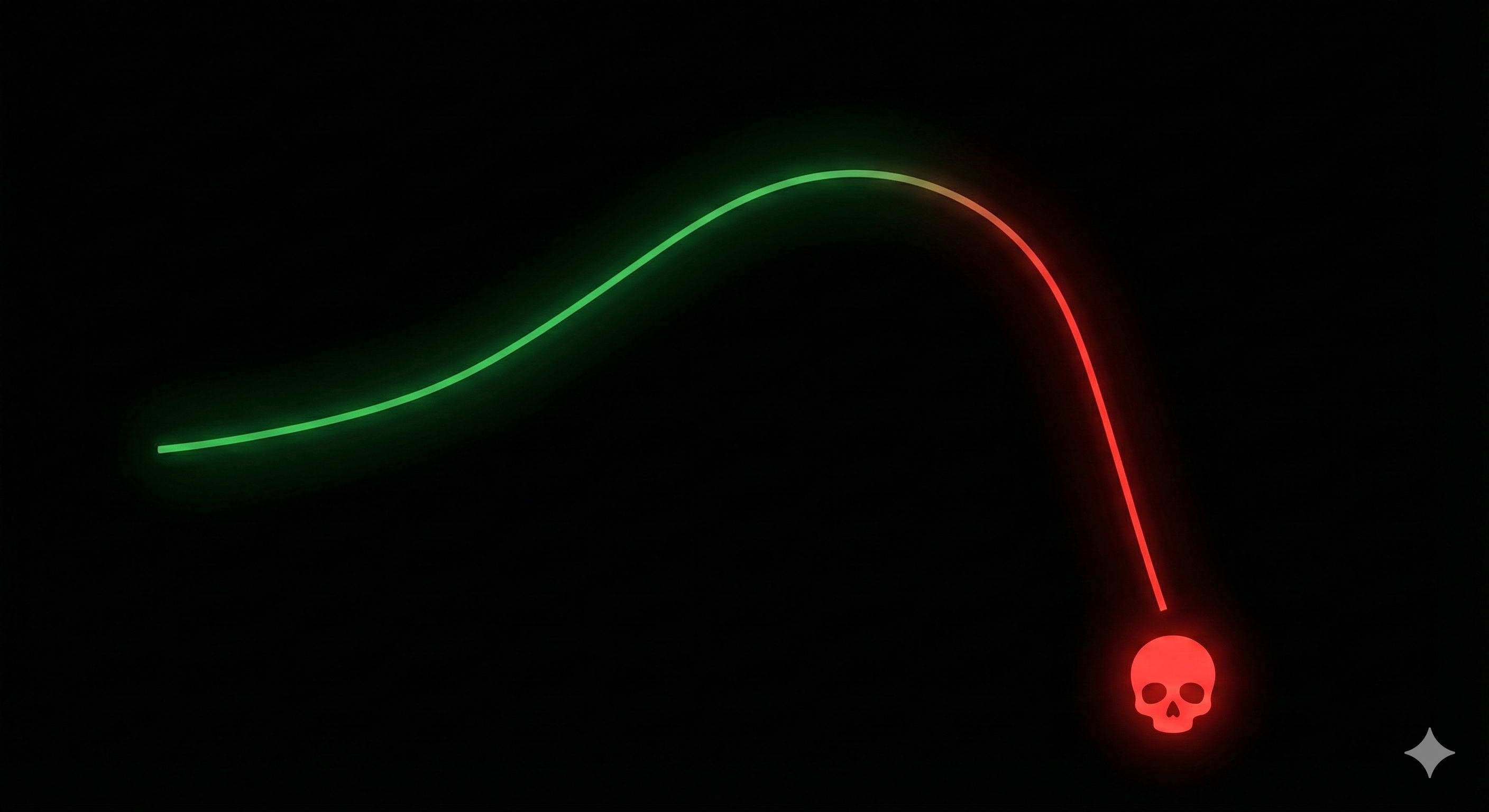
In the world of probability, there is a concept popularized by Nassim Taleb called the Absorbing Barrier.
It sounds technical, but it is actually terrifyingly simple. It is a point that, once reached, you cannot return from. In biology, the absorbing barrier is death. In trading, the absorbing barrier is Zero.
If you lose 50% of your portfolio, you need a 100% gain just to get back to even. That is hard, but possible. If you lose 100% of your portfolio, you are done. The game is over. You are removed from the simulation.
As a Tax Consultant, I spend a lot of time looking at balance sheets. I see businesses that took massive risks and won, and I see businesses that took massive risks and died. I saw other businesses that didn’t take enough risks and died slowly. The difference wasn’t always skill. Often, it was simply that one of them managed to avoid the barrier long enough for the coin to flip in their favor.
The Gambler’s Fallacy
Why do smart people hit the barrier? Why do rational traders blow up their accounts on a single leveraged long on SOL?
Usually, it’s the Gambler’s Fallacy.
It is the mistaken belief that if an event happens more frequently than normal during a certain period, it will happen less frequently in the future.
- “Solana has dropped 15% today; it HAS to bounce.”
- “I have had three losing trades in a row; the next one is due to be a winner.”
The market has no memory. The chart does not know you are down. The algorithm does not care about your rent payment. The probability of the next candle being green or red is completely independent of how much pain you are currently in.
When you bet big because you feel a reversal is “due,” you are walking blindfolded toward the cliff edge.
The House Always Wins (Because They Have No Barrier)
The reason the “House” (the market/exchange/casino) always wins in the long run is not just because the odds are slightly in their favor. It is because they have infinitely deep pockets.
If the Casino loses $10 million tonight, they are still open tomorrow. They have no Absorbing Barrier, or one that is so far away it can’t be hit quickly. If you lose $10,000 tonight, you might be out of the game.
To be a ChartDrifter—to have “Capital Without Borders”—you must first ensure you have Capital.
How I Stay Alive
I don’t trade to get rich on Tuesday. I trade to be able to trade on Wednesday. Here are the rules I use to stay away from the barrier:
- Define the Invalidation (The Stop Loss): The topic of Stop Losses is controversial. Do you use “Hard Stops” on the exchange and risk getting wicked out by liquidity hunters? Or do you use “Mental Stops” and risk freezing when the price moves against you? We will drift into those weeds in a future post. But regardless of the mechanics, you must have a price where you admit you are wrong. Moving that line further down because “it might bounce” is the first step toward Zero.
- Sizing by Math, Not Feel: I don’t lick my finger and put it in the wind to decide how much to bet. I use a specific calculation based on a fractional Kelly Criterion. It’s a formula designed to maximize growth while mathematically eliminating the risk of ruin. The math is heavy, but the output is simple: the bet size shrinks as the bankroll shrinks. This ensures that no single string of bad luck can ever push me into the barrier.
- The “Tuition” Account: I keep my trading funds completely separate from my life funds. The money I need for my mortgage, my taxes, and my travel to Cancun never touches the exchange. If my trading account hits zero, my lifestyle doesn’t change. I just have to stop trading.
The Ultimate Utility
In crypto people talk a lot about the utility of tokens. Does this coin have a use case? Is the tech good?
But the most important utility of money is freedom. When you risk money you cannot afford to lose, you are not gambling with currency. You are gambling with your freedom. You are risking your ability to say “no,” your ability to travel, and your peace of mind.
Earlier I referred to “tuition”. The fact is, beginning traders are quite likely to blow up, especially in crypto. If you are trading with leverage, the pull of betting big on a ‘sure thing’ trade is so seductive. Then, when you are staring at your monitor, watching it go the wrong way, you start to rationalize. “If this was a good buy at $149.00, it’s a better buy at $148.00.” So you increase the leverage. Then again at $145 – how could it not start to climb now? And then it drops again. These lessons are painful – but if you were using money you couldn’t really afford to lose, they are worse. Accept that not every trade will be successful, that you strategy that back-tests with a 60% win rate can still lose 3 trades in a row.
Don’t trade your freedom for a chance at a Lambo. Stay away from the barrier. Keep drifting.
The Fine Print
I am a consultant, but I am not your financial advisor. The content on ChartDrifter is a personal log of my strategies and is strictly for educational and entertainment purposes. I am sharing what I do with my capital, which matches my specific risk tolerance. Cryptocurrency markets are highly volatile. Never trade with money you cannot afford to lose, and always perform your own due diligence before pushing a button.