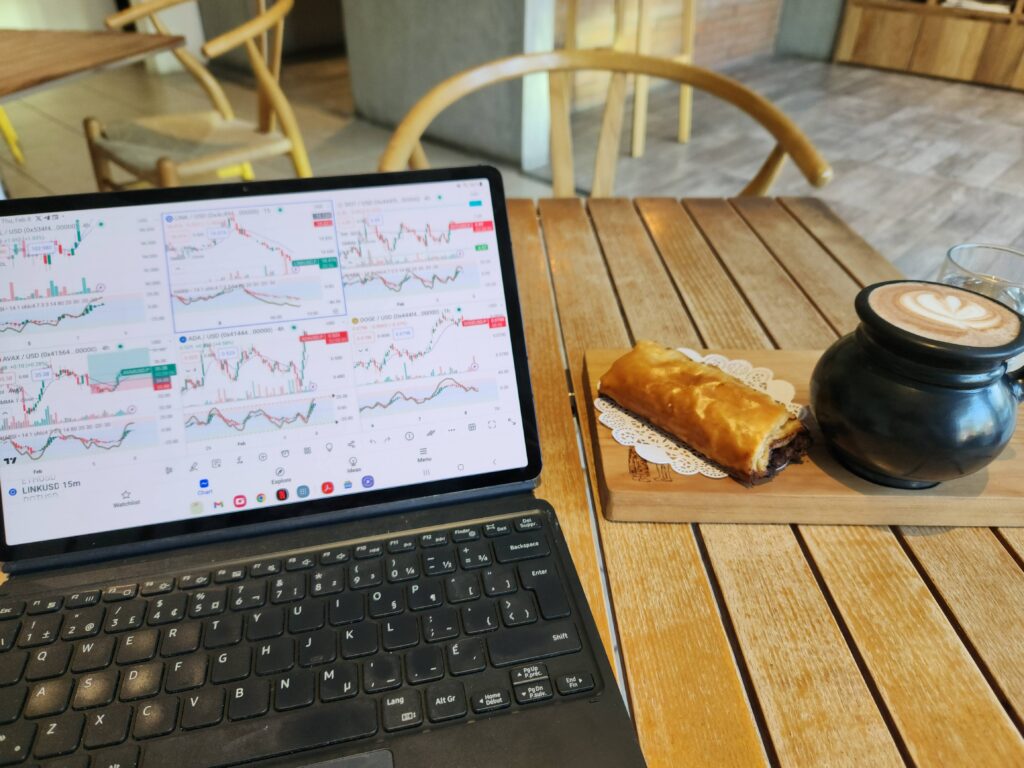
When I was shopping for a tablet, it came down to a heavy-weight title fight: In the Red Corner: The Samsung Galaxy Tab S11 Ultra. A 14.6-inch AMOLED beast. 120Hz refresh rate. Faster than my laptop. Capable of running 4k video, 12 charts, and a live stream simultaneously. In the Blue Corner: The Boox Tab XC. An E-Ink tablet. It is essentially a giant, color Kindle that you can write on. It has a “ghosting” effect if you scroll too fast. Video looks like a slideshow.
The Samsung is objectively the “better” computer. But I bought the Boox. And while it is the slowest computer I own, it has become the most profitable.
The Allure of the Everything Machine
We are addicted to “Everything Machines.” We want a device that can do email, Slack, trading, Netflix, and Twitter all at once. The problem is that the human brain cannot do all of those at once.
If I bought the Samsung, I know exactly what would have happened. I would sit down to review a consulting PDF. Ping. An email from a client. Ping. A “breaking news” notification on X. Ping. A WhatsApp message from the family group chat. Ten minutes later, I am doomscrolling Instagram Reels while the PDF sits unread in the background. Forty minutes later I might finally get back to the PDF, after a prolonged detour through X and YouTube.
The Samsung S11 is designed to capture your attention. The Boox is designed to leave you alone.
The Boox Setup: Monk Mode
I didn’t just buy the device; I set it up with a specific protocol. This is my “Monk Mode” configuration:
- No Email: I did not sign into Gmail.
- No Socials: No X, no Instagram, no WhatsApp.
- No Notifications: The notification shade is empty. Always.
This device is not a portal to the internet; it is a stack of digital paper. When I pick it up, my brain knows there are only two options: Work or Read. There is no dopamine escape hatch.
Separation of Powers: The Library vs. The Cockpit
“But how do you trade on E-Ink?” I don’t.
I have a dedicated “Cockpit” for execution: a powerful MiniPC driving dual large monitors. That is where I have the order books open, TradingView loaded, and the execution buttons ready. That is where I go to act.
But you cannot learn in the Cockpit. It is too loud, too fast, and too bright.
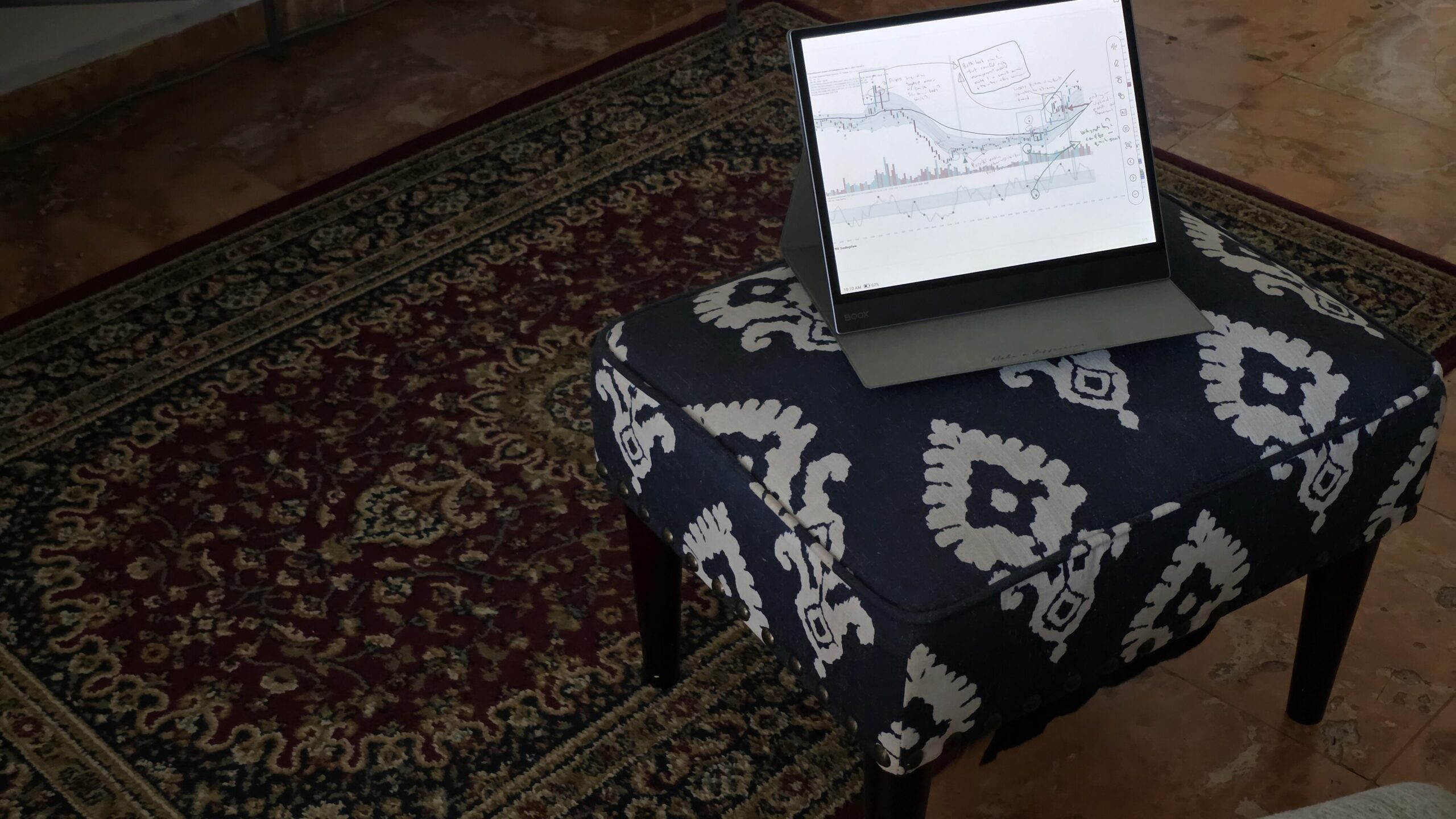
The Boox is my “Library.” It is where I do my backtesting and pattern recognition work. My workflow is tactile:
- I print historical charts (from yesterday or last week) to PDF.
- I send them to the Boox.
- I sit on the couch with the stylus and dissect the price action.
There is something magical about writing by hand. When you annotate a chart on a glass screen (like an iPad), the stylus slides around. It feels slippery and fake. On the Boox Tab XC, the screen feels different. Now, the XC doesn’t have a defined texture like some notepad devices, but it has a strange haptic feedback in the stylus. And it works. It feels like pencil on paper.
I circle key levels. I draw arrows. I scribble notes like “This was a trap” or “Here is the liquidity sweep.” Because the screen is slower, I become slower. I can’t rapid-fire click through timeframes. I have to sit with the static image. This forces me to analyze the structure, not the noise.
Before I got the Boox I had a stack of Moleskine notebooks. When I moved between Canada and Cancun I had to allocate a meaningful amount of space in my carry on for them. Now – just one device can replace more Moleskines that I could carry. And it has several e-books, a serious amount of work related content, and even runs TradingView, if I want to check out the current chart.
I am not looking for a trade to take now. I am training my eyes to see the setup when I am back in the Cockpit tomorrow.
The Consultant’s Workflow: Deep Work
As a Tax Consultant, I deal with density. 50-page legal briefs, valuation reports, and case law. Reading these on a backlit LED screen is exhausting. The blue light fries your eyes, and the constant “hum” of the internet drains your battery—both the device’s and your own. And, as mentioned before, there is a never ending stream of notifications to divert your attention.
On the Boox, I can read for four hours without eye strain. I can highlight, margin-note, and digest complex information without a single notification breaking my flow. It turns “Work” into “Reading.”
It is even better when I am travelling. When on a plane for four hours, there is a temptation to just be entertained. Especially with most flights having Wi-Fi these days, Netflix and YouTube can make the time fly by (pun intended). But what if much of that time was spent doing analysis, reviewing work documents, or even just reading a good book? Wouldn’t that feel better than dozing off while watching House MD, Season 1 Episode 21 for the fifth time? (It’s close – that is a really good episode).
The ROI of Clarity
In a world that screams for your attention, silence is a competitive advantage.
The Samsung S11 Ultra would have been a “better” tablet. It would have given me 4k movies and flashy games. But the Boox gives me something the Samsung can’t: Clarity.
It is the only screen in my house that doesn’t want anything from me. It just waits for me to think.