There is a dirty secret about trying to transition from a high-pressure career to full-time trading. Everyone talks about the capital required. Nobody talks about the cognitive cost of context switching.
Picture this: I am deep in “Consulting Mode.” I have three monitors open, finalizing a valuation model. My brain is running hot, holding 15 different variables in my working memory. I am in the flow.
DING.
A TradingView alert fires on my phone. “BTC crossing key resistance.”
My immediate reaction isn’t excitement. It’s anger. I feel genuine irritation that this “opportunity” dared to interrupt my deep work. Maybe not everyone feels this way, but even one momentary interruption feels like the last in a series of non-stop interruptions. The issue is that people don’t generally task switch well. Once we switch from a deep concentration task, it is not easy to get back in.
The Dilemma
At that moment, I have two bad choices:
- Ignore the alert: Stay focused on the consulting work, keep the client happy, but miss the trade that is supposed to buy my eventual freedom.
- Take the trade: Switch screens, analyze the chart, calculate risk, and execute.
Option 2 seems obvious, but here is the hidden cost: When I switch tasks, my brain dumps its “RAM.” All those 15 variables I was holding for the consulting project evaporate.
I take the trade. It takes 90 seconds to set up. I’m there for a few minutes, making sure everything executes correctly. Stop Loss and Take Profit are all set up. I set a few alerts to monitor the progress of the trade. All in all, I lose maybe 10 minutes to the trade.
But when I switch back to my work monitors, I am completely lost. I stare at the cursor blinking in the middle of a paragraph. Research from UC Irvine shows it takes an average of 23 minutes to recover from an interruption, not including the time spent on the interrupting matter. If you do that three times a day, you have lost over an 90 munites of deep work to ‘transition lag.’ Three trades in one day blows up an hour and a half of my day, assuming the trades play out quickly.
At this point you aren’t moonlighting. You are just doing two jobs badly.
The “Save State” Concept
I realized I couldn’t rely on willpower to hold onto that mental context. My brain—perhaps like yours, especially if you wrestle with focus issues—is terrible at rapid context switching.
I needed an external hard drive for my working memory.
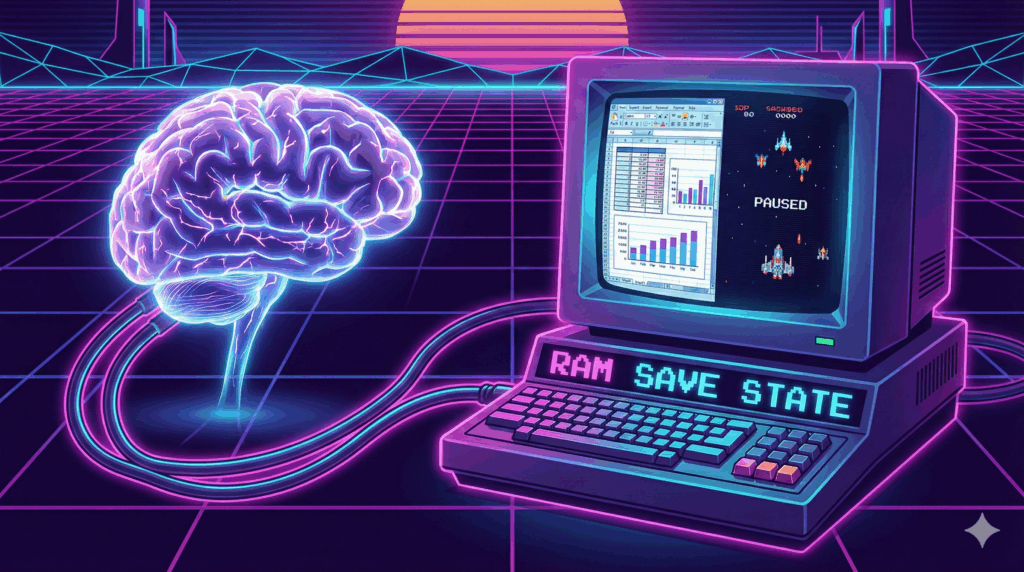
I borrowed a concept from video games and computing. In an emulator, you can hit a button to create a “Save State”—a perfect, frozen snapshot of everything happening in the game at that exact microsecond. You can walk away for a week, load the state, and resume instantly without reorienting yourself.
I developed a system to do this for my brain.
The Workflow: The AI Anchor
To make this work, you need frictionless capture. Typing a note breaks flow almost as much as switching screens. I use a dedicated chat with an AI (like ChatGPT or Gemini on my phone) that acts as my “Anchor.”
Here is the exact protocol when an alert fires:
1. The Pause (Crucial) The alert sounds. Do not touch the mouse. Do not alt-tab. Physically freeze.
2. The “RAM Dump” I open my AI Anchor chat on my phone and hit the microphone button. I verbally vomit everything currently in my working memory.
“Save State: I am on the Company X file, tab 4, cell G12. I just realized the 2023 costs seem low and I need to cross-reference them with the Smith report before I finish this paragraph. Particularly focus on Q4 costs as they seem at odds with prior years”
I hit send. The AI doesn’t need to reply with anything smart. It just needs to hold that thought.
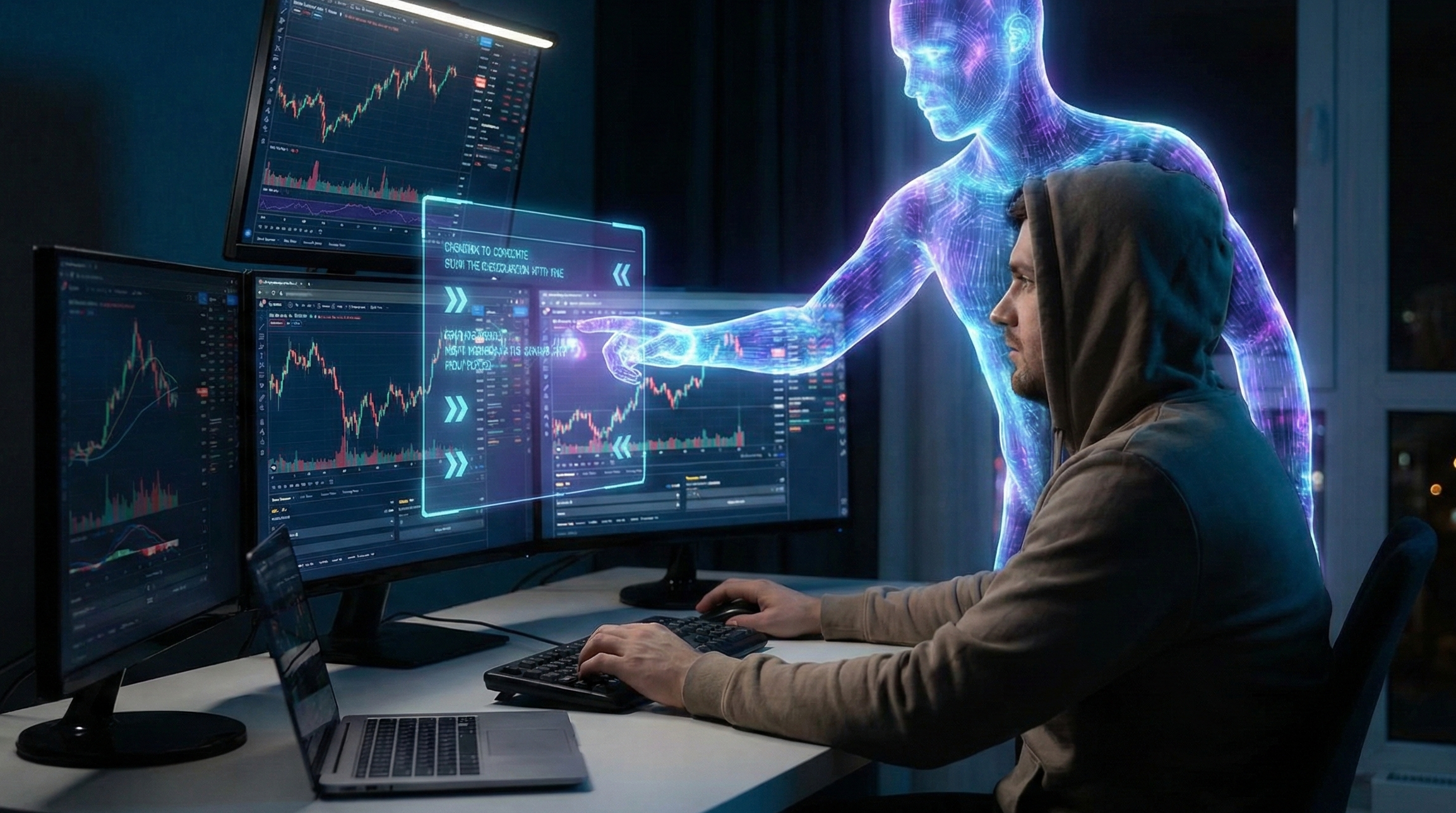
3. The Switch & Execute Now that my brain is empty, I switch desktops. I open the chart. I am fully present as a trader. I execute the setup, set my stop loss and take profit. The terminal is closed.
4. The Reload I switch back to my work desktop. Before I try to remember what I was doing, I look at my phone. There is my “Resumption Card”—a precise instruction manual for my brain on where to begin. I read it, and I am immediately back in the flow.
The Prompt
In the moment you will not want to be thinking of a prompt. You need a chat set up in advance, so all you do is brain dump. Here is my prompt:
The Protocol:
- Input: The user will provide a “brain dump” via voice/text (often messy, stream-of-consciousness) describing exactly what they were doing and what they intended to do next.
- Processing: You will strip away filler words, anxiety, and fluff. You will extract three core elements:
- The Project: (e.g., Company X Valuation, Hearing Prep for Smith File).
- The Location: (e.g., Paragraph 14, specific Excel tab, specific legal argument).
- The Next Action: The immediate physical action required to resume flow.
- Output: You will reply with a “Resumption Card” using the format below. Do not add encouragement, advice, or conversational filler. Just the card.
Format:
CURRENT STATE: PAUSED
📂 Project: [Project Name]
📍 Location: [Specific Document/Section/Tab]
⏩ IMMEDIATE NEXT STEP: [One specific, actionable sentence]
User (Voice Dictation): “Okay bookmark, I’m working on the Q3 Financial Model, I’m looking at the EBITDA projections on tab 4, I just realized the client sent the wrong expense data and I need to go find the October ledger to prove it, switching to trading now.”
AI Response:
CURRENT STATE: PAUSED 📂 Project: Q3 Financial Model 📍 Location: EBITDA Projections (Tab 4) ⏩ IMMEDIATE NEXT STEP: Find the October ledger to correct the client’s expense data error.
You want this as simple and straightforward as possible. The exact prompt you need to get back in it. Yes, you are having an AI treat you like an AI. It gives you a prompt, and you go to work. But if it can shorten the 23 minutes lost down to about 5, you are getting back a meaningful amount of your day.
Make no mistake – this isn’t perfect. The interruption still costs you something. But it costs you a lot less this way.
The Drift is Mental, Too
We talk a lot here about “The Drift”—moving physically between locations for a better life. But there is also a mental Drift. The ability to glide between your current identity (whatever that is today) and your future identity (the trader) without friction.
If every trade feels like a violent interruption to your workday, you will eventually resent trading. Unless you are blessed with hours and hours of uninterrupted time to devote to trading, you will be task switching.
Stop trying to hold it all in your head. Your brain is for processing, not storage. Offload the RAM, take the trade, and reload the state.