Backtesting is a seduction. When you scroll left and look at historical data, the entries scream at you. The patterns are crisp, the reversals are obvious, and the profit targets are hit with mathematical precision. In hindsight, you are a genius.
But the “live edge” of the chart—that flashing cursor on the far right—is a different beast entirely.
I touched on this in my post about the Bart Simpson pattern: in the moment, it is incredibly difficult to distinguish between a redistribution structure that will dump and a re-accumulation range preparing for trend continuation.
The “Delayed Send” Button Ever hit “send” on a massive client email and immediately wished for a five-second undo button, just to give it one last review? In my consulting work, I used to use a delayed send feature for exactly that reason. It bought me peace of mind.
The charts don’t give you that option. Once the moment passes, it is gone forever. So, in the moment, how do you deal with the uncertainty? Especially when you are just starting out, what gives you the psychological edge to say, “I’m going to trust my strategy and commit real funds to this trade”?
Right now, I am looking at a chart that illustrates this perfectly. We are in a range. Structurally, everything is lining up for a reversal. My bias is short. But there is a single indicator suggesting continuation. It’s a classic “almost ready” moment. The novice trader relies on vibes and intuition here, forcing the trade because they want the reversal to be true.
The disciplined trader relies on strategy design to bridge the gap between “it looks good” and “execution.”
The Limit Order Trap
Standard advice often pushes traders toward limit orders to maximize R-multiples. If I want to short, I place a limit order above price and wait for it to get hit. The problem? A limit short is only triggered when price is actively moving up.
You are stepping in front of a moving train, betting that the tracks end exactly where you are standing. If you are wrong, you are wrong immediately and often violently.
The Stop Entry Solution
This is why one of my core approaches is the Stop Entry.
Instead of trying to catch the absolute top tick, I set a sell stop below the current price action. I am essentially saying: “I will only enter this short if the market proves it is actually going down.”
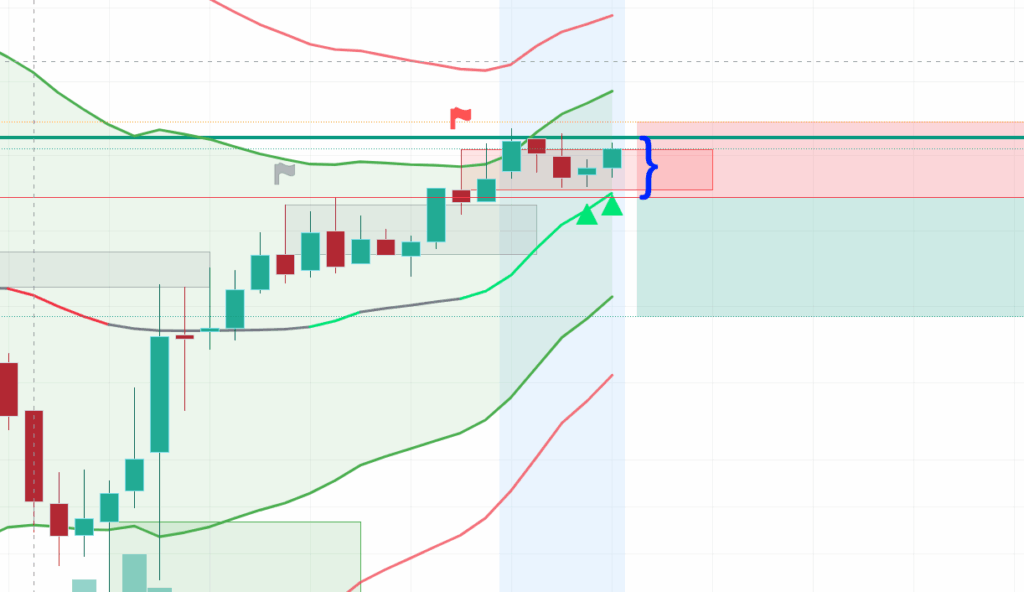
Look at the graphic above.
- The Conflict: I have multiple indicators and past chart movement suggesting this is the top of a local range and price is about to drop. However, see those green triangles? That is an indicator I coded to identify trend continuation—it is insisting that price is going to keep heading up.
- The Trap: The dark green line is my theoretical entry point. If I were playing the standard “limit order” game, I would already be in the trade.
- The Solution: Instead, I have set my trade entry lower. The blue bracket represents the gap between the theoretical optimal entry and where I actually plan on entering.
The Confirmation Tax
Yes, this means I give back a little. I am entering at a slightly worse price than the limit order trader. I also pay higher fees because I am triggering a “taker” order rather than a “maker” order.
I call this my Confirmation Tax.
I am happy to pay it because that tax buys me security. It filters out the noise. If those green triangles are right and the price rips upward, my short order is never triggered. I stay flat, my capital is safe, and I live to trade another setup.
Trusting the Design over the Vibe
Does this fix everything? No. There is no 100% strategy. I can still get triggered into a trade on a wick, only to watch price reverse and stop me out.
But this approach shifts the psychological burden. I don’t have to guess if the reversal is real; I let price action dictate the entry.
I will do another post in the future about how eliminating losing trades is just as important as finding winning ones. This is one way I do that—a little buffer. Yes, it knocks down the Risk/Reward ratio slightly, but it boosts the win rate.
More importantly, it relieves stress. Because I enter on momentum, most of my trades are in profit the moment I enter, and they often stay that way until I exit.
If the trade triggers and fails, it’s just data. It’s a business expense. But I refuse to lose money guessing on a vibe. I need the chart to show me its hand before I put my chips on the table.