In a previous post, I detailed how a burst of creative fiction writing led to a “Fat Finger” error that cost me money. I was trying to be an author and a trader in the same exact second.
The human brain cannot do this. My brain, specifically—which I have described as having a powerful engine but no steering wheel—definitely cannot do this.
We are told that to be a successful trader, we must be “glued to the screens.” We picture the wall of monitors, the ticker tape, the sweat. But that is not trading; that is anxiety with a P&L attached.
I refuse to live like that. I want to vanish into deep work—writing, consulting, or just living—and only surface when there is a trade ready to execute. Or almost ready.
To do this, I had to stop using trading alerts as “alarms” and start using them as “Sentinels.”
The Problem with the “Entry Price” Alert
Most traders set one alert. They identify a resistance level at $150. They want to short it. So they right-click the chart at $150 and set an alert: “Crossing Up.” Or they have some indicator they rely on: TradingView flashes “MACD crossing over”. The hope is that they will jump into the trading window and book a trade on the spot. (TradingView – Full disclosure: This is a referral link. If you sign up, I get a small commission. I believe in capturing the vigorish where available.)
This seems logical. It is actually disastrous.
When that alert fires, the price is already at the execution point. You are ripped violently from your deep work. Your heart rate spikes. You have zero seconds to prepare. You have to switch contexts, load the chart, calculate the risk, and pull the trigger instantly.
This creates panic. Panic leads to “Fat Fingers”. It leads to forgetting your rules.
You need a buffer. You need a system that respects your cognitive RAM.
The Three-Tier Hierarchy
I don’t set single trading alerts. I build a perimeter. I call it the Sentinel System.
1. The Scout (The “Wake Up”)
This alert is set to trigger when conditions are almost right. If it was pure price, we would be a small amount away from my area of interest. If you trade based on RSI moving from oversold back into a normal range this alert would be for when RSI left the normal range. I don’t want to know for the first time that RSI is dropping back to normal, I want to be warned when it leaves normal, and maybe again when it starts to drop.
- The Message: “Approaching Zone.”
- The Action: This alert is a gentle tap on the shoulder. It tells me, “Wrap up what you are doing. Save your state.”
When the Scout fires, I do not open the exchange. I finish my sentence. I dictate my “Save State” note to my AI anchor. I calmly close my work tabs and open my trading terminal. I am not reacting; I am preparing.
2. The Sniper (The “Execute”)
This is the standard alert at the specific level I want to trade.
- The Message: “EXECUTE SHORT.”
- The Action: By the time this fires, I am already at the desk. My size is calculated. My limit order is ready. The alert is just the green light.
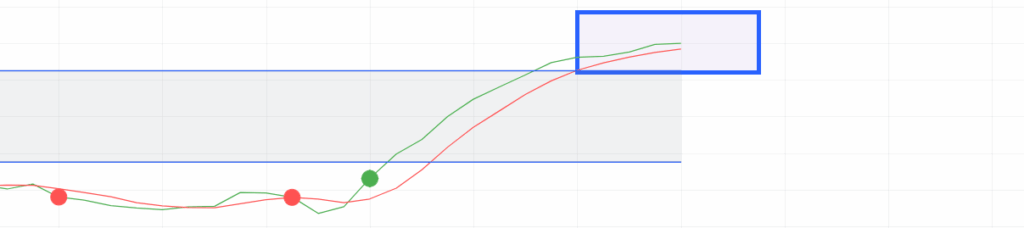
Because the Scout already summoned me, the Sniper doesn’t startle me. It just confirms me. It is just a mechanical confirmation of what I can already see. So why bother with this one? Because one of the most important elements of a trading system is preventing the trader from taking almost good enough trades. You want to execute only when it is a mathematical certainty.
3. The “All Clear” (The “Stand Down”)
This is the alert nobody uses, but it is the most important one for your mental health.
Consider the following simplified example: Let’s say I am looking for a short at $150. The price is at $140. I set a Scout at $148. But what if the price drops to $130? The setup is dead. The opportunity is gone.
If you don’t set a cancellation alert, a part of your brain stays “on.” You keep checking your phone. “Is it there yet? Did I miss it?” Or worse, you actively keep it alive and try to force the trade which is now disproven. This is the “Leash of the Alert”.
I set an alert below the current price structure that says: “Setup Invalidated / Trend Broken.” Note – this can happen even if you are actively staring at the chart. Let’s say that like me you prefer to enter with momentum. You think you have figured out the local top, so you tell yourself you will short only after the price hits $150, but then falls to $149.50. You set up a stop entry so that when you enter price is already moving in your desired direction. (Note – while this might increase the fees, I have found this change alone eliminated over half of my losing trades).
So price goes up to $150.00,
then $150.10,
then drops to $149.80,
$149.70,
$149.65.
Then – it starts climbing again, and soon enough it rising past $151.00.
Now – two things just happened. First – you may have just missed a losing trade. But second – you know it isn’t going to happen. Having a fixed level or set of levels that tell you “this opportunity is not going to happen” can free up significant brainpower.
- The Message: “Go back to sleep.”
- The Action: If this fires, I delete the other alerts and go back to writing. I don’t check the chart. The Sentinel told me the enemy retreated. I am free.
The ROI of Silence
This system sounds like more work. It is three clicks instead of one. But the ROI is not measured in time; it is measured in focus. This is especially important for those of us with attention difficulties. Our greatest superpower can be hyperfocus, that intense flow state where we get totally lost in something. But if you are trying to do two things, and trading interrupts the other one, it can take some time to get fully oriented in the trade. You look at the screen, your alert told you a state was changing. Before you fully process what is happening you take what appears to be an obvious short, without noticing that while the immediate appearance is a short this is just a pullback before a big upmove.
By using the Scout, I protect my creative flow from the violence of the market. By using the All Clear, I protect my downtime from the “Phantom Loss” of missing out.
I don’t watch charts. I wait to be summoned.
The Fine Print
I am a consultant, but I am not your financial advisor. The content on ChartDrifter is a personal log of my strategies and is strictly for educational and entertainment purposes. Never trade with money you cannot afford to lose.+1