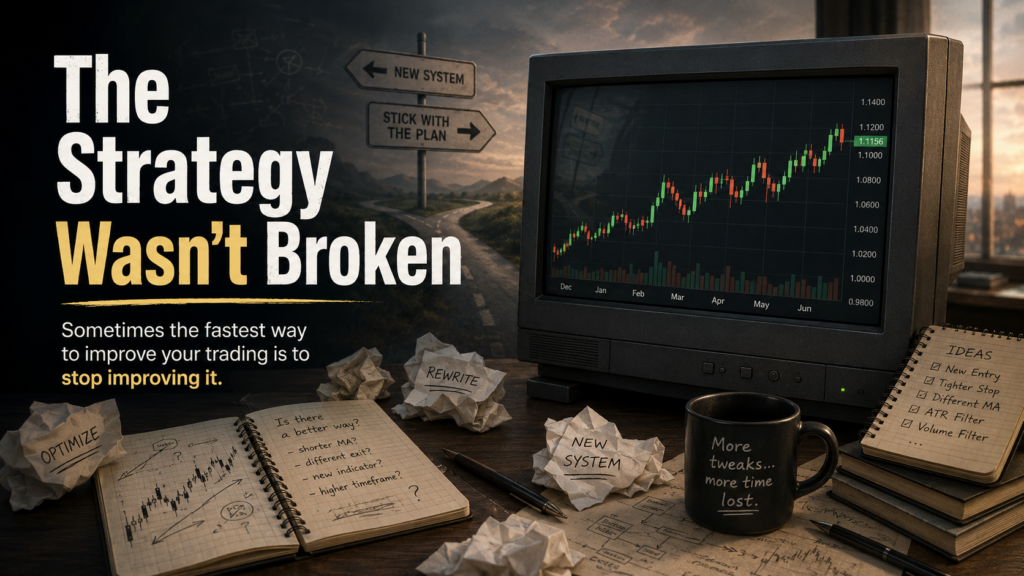
Sometimes the fastest way to improve your trading is to stop improving it.
I am sitting here looking at an old television that I have never bothered to replace.
It is not especially impressive. It is not particularly large, thin, smart, bright, immersive, or whatever televisions are supposed to be now. I am sure a new one would be better. The picture would be sharper. The menus would be quicker. It would probably have features I do not know I need yet.
But the old television still works.
It turns on. It shows me what I want to watch. Replacing it would cost money, require research, involve comparing models, and probably leave me wondering whether I had chosen the right one. Then I would have to take the old one off the wall, dispose of it, and mount the new one. Finally I would have to make sure it worked with all my existing devices – gaming console, surround sound, streaming box. All of that effort would produce an improvement, but not necessarily one that would change my life very much.
Looking at it, I realized that I have not always shown the same restraint with trading strategies. I have had methods with a demonstrated edge. They produced good setups. They generated profitable trades. Their rules made sense, and their weaknesses were manageable with sensible risk control.
Then I would lose a couple of trades.
Almost immediately, the system would begin to look inadequate. I would spot an indicator that might improve the entries, a filter that might remove some of the losses, or an entirely different approach that seemed cleaner, faster, and more precise. Before long, I was no longer trading. I was refining. Then I was rebuilding. Then I was back-testing the rebuilt version, comparing it with three alternatives, adjusting the settings, and waiting until I felt sufficiently confident to begin again.
Meanwhile, the market continued without me.
The Problem Was Not Always the Strategy
There is nothing wrong with improving a trading method. Every serious trader should review results, study mistakes, test ideas, and refine the process.
The problem begins when refinement becomes continuous.
A trading strategy needs time and repetition to reveal its edge. It cannot be judged fairly after one loss, two losses, or even a brief cluster of losses. Every workable method will lose trades. Many will lose several in succession. That is not necessarily evidence that something has broken. It may simply be the normal distribution of outcomes.
But losses have a way of making the current strategy feel uniquely defective.
A different method always looks cleaner from a distance. Its losing streaks are theoretical. Its rules have not yet annoyed us. We have not watched it miss an entry by a few ticks or take a technically valid trade that immediately reverses. The new strategy exists mainly as possibility. The current one exists as lived experience, complete with frustration, doubt, and recent losses. That comparison is rarely fair.
Looking back, some of the systems I abandoned were excellent. My current method may be better, but that does not mean the earlier ones were untradeable. In several cases, I probably would have progressed much more quickly by following the proven method consistently than I did by repeatedly stopping, rewriting, and starting again.
I kept trying to become the designer of a better trading system when what I often needed was to become a more faithful operator of the system I already had.

Buridan’s Donkey Goes Trading
There is an old philosophical illustration commonly called Buridan’s donkey.
The donkey is placed between two equally attractive sources of food. Unable to identify a rational reason to choose one rather than the other, it remains trapped in indecision. The point is not that either choice is bad. The point is that the demand for a clearly superior choice prevents the donkey from benefiting from either one.
A more modern version might involve driving somewhere with two possible routes. Route A and Route B are notably different, but neither is obviously superior. One may be slightly shorter. The other may have less traffic. Either one would get you to your destination in reasonable time. The sensible thing is to choose a route and drive. Instead, imagine spending fifteen minutes comparing them. You finally begin down Route A, then start wondering whether Route B would have been faster. You turn around, double back, and try the other route. A few minutes later, traffic slows and you begin wondering whether your first choice was right after all.
By the time you arrive, neither route was responsible for the delay. The delay came from refusing to commit to a known good route.
Trading can work the same way. There are many viable ways to approach a market: trend following, breakouts, mean reversion, momentum, support and resistance, higher-time-frame swings, or shorter-term continuation setups. Each has strengths. Each has weaknesses. None captures every move.
With a genuine edge, clearly defined rules, and sensible risk management, many of these approaches can work. The trader does not necessarily need to discover the one perfect route. The trader needs to choose a workable one and remain on it long enough to reach the destination.
Switching Strategies Can Increase Risk
Constantly changing methods may feel like risk reduction. It often does the opposite.
Imagine that a strategy wins two trades and then loses one. The trader becomes nervous after the loss and abandons the method. Perhaps the next three valid setups would have been winners. The trader has now accepted the loss from the original strategy but denied himself the opportunity to collect its subsequent gains. He has captured one small and misleading section of the system’s outcome sequence and treated it as a complete verdict.
Then he begins again with another method.
The same problem occurs when a trader does not completely abandon the strategy but sharply reduces risk after a routine loss. The losing trade was taken at full size, but the next winning trades are taken at a fraction of the size. It may then require several good trades merely to recover from one ordinary loss. This creates a peculiar asymmetry. Fear determines the position size more than the quality of the setup does.
The trader risks more when confidence is high, often after recent wins, and risks less when confidence is low, often after recent losses. Yet the next trade does not know what happened on the previous one.
Unless the losing trade revealed a genuine flaw, there is no mathematical reason that the next valid setup should deserve less risk.
A strategy’s edge emerges across a sequence of trades. Constant switching interrupts that sequence. Reactive position sizing distorts it further. Think of it. For ease of calculation let’s assume that a strategy produces 2 winners for each losing trade, 1:1 RR, and the trader has set a 2% risk for each trade. He loses a trade, then decides to cut his position size in half. The next two trades win, but instead of now being positive, he is down – remember the winners came after the loser, so they are 1% of a slightly smaller stake.
The danger is not only that the new strategy may be worse. The greater danger is that the trader becomes incapable of following any strategy long enough for its expectancy to appear.
He takes the losses from one method, the hesitation from another, and the undersized wins from a third.
Then he concludes that he needs to start over.
The Search for Improvement Can Become Avoidance
Strategy development feels productive.
There are charts to study, indicators to compare, statistics to calculate, and rules to rewrite. The work is intellectually engaging, and every adjustment carries the promise that the next version will be easier to trust.
It is also safer than trading.
Back-testing does not require placing capital at risk in real time. A historical chart does not create the emotional pressure of an open position. Rewriting the rules allows us to remain in control, while executing the rules requires us to accept uncertainty.
That does not mean strategy work is dishonest or useless. It means we should be alert to the possibility that improvement has become a sophisticated form of avoidance.
The perfect strategy is especially useful in this regard because it can never be finished. There is always another filter to test, another time frame to examine, and another losing trade that might have been prevented.
The trader can remain busy indefinitely without ever becoming consistently exposed to the results of a stable method.
At some point, the pursuit of a better edge becomes less important than the discipline required to harvest the existing one.
Trade During Trading Time
The practical answer is not to stop refining. It is to separate refinement from execution.
During active trading periods, trade the current playbook. When a possible improvement occurs to you, record it. Note the setup, the concern, and the change you are considering. Do not immediately rewrite the system in the middle of the week or after one frustrating result.
Then examine those ideas during defined development periods.
That might mean weekends, monthly reviews, or after a predetermined sample of trades. Major revisions should be based on evidence gathered across enough trades to be meaningful, not on the emotional intensity of the most recent outcome. This creates two distinct modes. In execution mode, the job is to follow the tested process. In development mode, the job is to question it. Both are necessary, but they should not constantly interfere with each other.
You would not pull apart an engine every time it made an unfamiliar sound while you were driving down the highway. You would note the concern, reach a safe place, and inspect it properly. Trading strategies deserve the same basic courtesy.
Good Enough to Trade
A strategy does not have to be perfect. It does not even have to be the best strategy available.
It needs to be workable. It needs understandable rules, a plausible and preferably tested edge, losses that can be survived, and risk management that prevents a normal losing sequence from becoming catastrophic. Once those conditions are present, the greatest improvement may not come from another indicator or another rewrite.
It may come from consistency.
The old television in front of me could certainly be replaced with something better. Perhaps one day it will be. But I do not need to spend this afternoon comparing televisions when the one I have already does its job. Trading methods are not televisions, of course. A defective strategy should not be preserved out of nostalgia or stubbornness. Real weaknesses should be examined, and genuine improvements should be made.
But a workable strategy should not face an existential crisis every time it loses a trade. Sometimes the route is fine. Sometimes the machine is fine.
Sometimes the strategy was never broken.
Sometimes the fastest way to improve is to stop improving it long enough to trade it.