
There is a seduction in trading called “Catching the Top.” You see a massive green candle shoot up, hit a level, and leave a long, ugly wick behind it. It looks like the market just touched a hot stove. The amateur instinct is to short immediately. You want to be the hero who sold the exact top. You want that “Zero Drawdown” entry.
I don’t do that anymore. Because more often than not, that “rejection wick” is just a speed bump. The market catches its breath, ignores the wick, and steamrolls right over your stop loss.
I don’t try to catch the knife. I wait for the Retest.
Defining the Trend: The Rigor of Structure
Before we look at the specific setup, we need to define what we are actually looking for. Many traders identify trends by “feel.” They squint at the chart and say, “It looks like it’s going up.” The human brain is an amazing pattern recognition machine, but it is also easily fooled. We need a rigorous definition.
- Uptrend: A series of Higher Highs and Higher Lows.
- Downtrend: A series of Lower Highs and Lower Lows.
That is it. That is the entire game. If price is making Higher Highs, you do not short it. I don’t care how “overextended” the RSI says it is. I don’t care about the news. If the structure is Higher Highs, the trend is Up.
The Micro-Trend Strategy
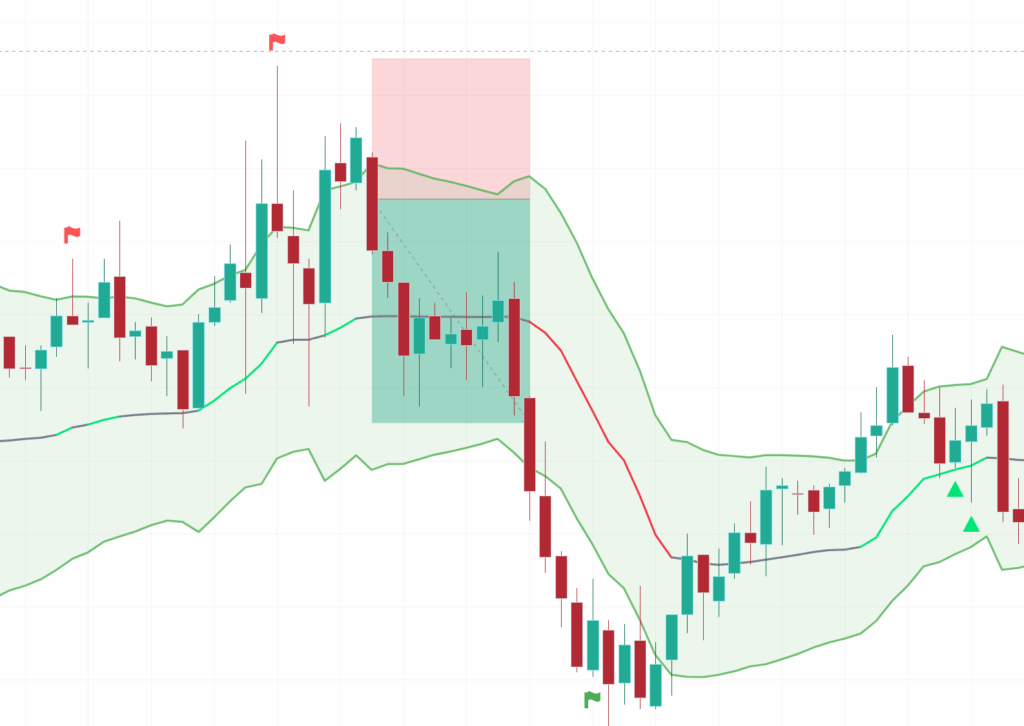
This is why the “Retest” is so powerful. Look at the chart below. To the left of the shaded box, we see a violent rejection—a tall wick reaching up to a new high. But a wick alone is not a downtrend. A wick is just a rejection.
I view the subsequent price action as a Micro-Trend forming. The market attempts to push back up to that high. It tries to resume the Uptrend. But it fails. It runs out of steam and turns around before it can break the previous high.
What has it just created? A Lower High.
This is the first structural signal that the Uptrend might be broken.
- The Wick was just a warning.
- The Retest (Lower High) is the confirmation.
Enter With Momentum
Notice where the entry (the start of the green box) is. I didn’t sell at the top of the wick. I didn’t even sell at the top of the retest. I sold when Momentum returned.
I wait for the price to start moving aggressively in my direction (the red candles). I want to see the floor drop out. Yes, I missed the first 5% of the move. I “left money on the table.” But in exchange for that 5%, I bought Certainty. By entering with momentum, I am stepping in exactly when the other side gives up. The problem with entering at the top of the wick is – how do you know it is the top? But if you are shorting, and you enter when price is already moving down, you are in a position to win. You won’t win every time, but your odds are better.
Note that this is a refinement of the simple entry presented in the post on Bollinger Bands. You will take fewer trades when you wait for a retest. You will miss some winners. But, more importantly, you will miss some losers too.
The Paradigm Shift: When to Accept Defeat
Here is the hard truth: Sometimes the retest fails. Sometimes the price puts in a lower high, you enter short, and then the market rips right back up and blasts through the ceiling.
This is why we set Stop Losses. And this is why we never move them. Remember that trading is about percentages, and percentages have a bias. If you lose 33% on one trade, you don’t have to make 33% on the next trade to make it back, you have to make 50%. If you lose 50%, you have to make 100% to recover. And if you lose 100%, well, then you have hit the absorbing barrier.
When the price breaks that previous high, the “Paradigm” has shifted. That is no longer a retest you are looking at, it is a continuation.
- Old Paradigm: “Test, Pullback, Retest, Reversal.”
- New Paradigm: “Trend, Pullback, Continuation.”
If you sit there moving your Stop Loss further away, thinking “It has to turn around soon,” you are trading a fantasy. You are applying the logic of the Old Paradigm to a market that has already entered the New Paradigm.
As John Maynard Keynes (supposedly) said:
“The market can remain irrational longer than you can remain solvent.”
If your Stop Loss hits, the market isn’t “wrong.” The market just told you that you were betting on a reversal in the middle of a continuation. Accept the loss. Preserve your capital. Live to hunt the next Lower High.
Quality > Quantity
If you try to catch every wick, you will take ten trades. Six of them will be “fake-outs” where the trend continues up and stops you out. Four will work. You will churn your account to zero.
If you wait for the Retest—for that Micro-Trend to confirm a Lower High—you might only take three trades. But two of them will likely be winners. You miss the “perfect” entry, but you avoid the “guaranteed” losses.